Structured diabetes education improves outcomes, including in African trials, yet it is not reliably delivered as routine care, and published data on its reach are scarce. This brief sets out why the implementation gap forms, why it matters most in Africa, and five conditions organisations need for reliable, sustained delivery.
Structured diabetes education has been shown to work, including in African settings. Why it is not yet reliably delivered as routine care, and what health systems need in place to change that.
DIABRIDGE Insights · Executive Brief 01 · September 2026
By Dorathy Oparaeche, Founder & Clinical Lead, DIABRIDGE Healthcare Services Ltd
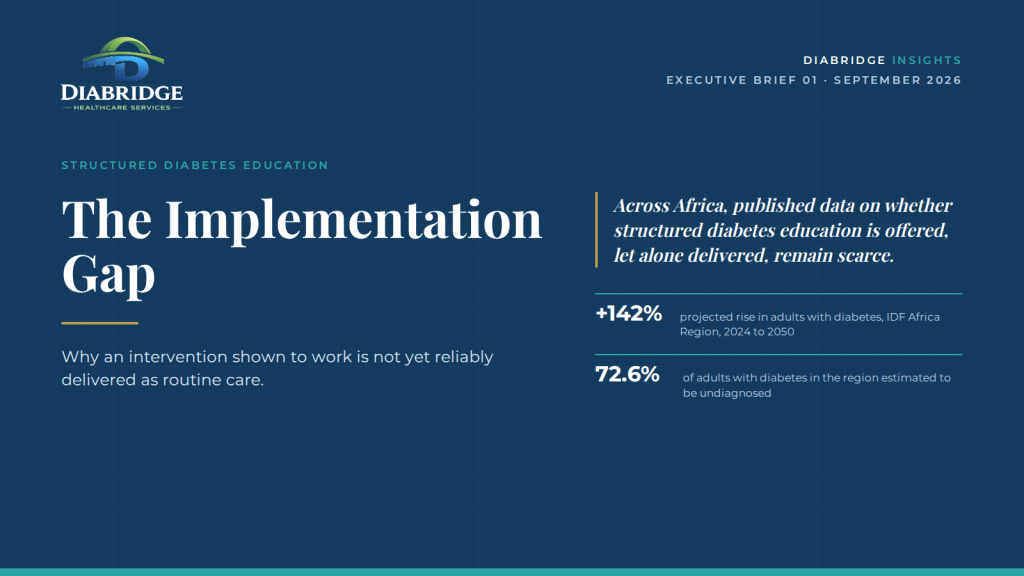
Across Africa, published data on whether structured diabetes education is offered, let alone delivered, remain scarce.
Key messages
- Education works, over time. A 2025 meta-analysis of randomised trials found nurse-led structured education lowered HbA1c by around 0.92 percentage points at three to six months, with a smaller benefit beyond six months. No statistically significant difference was detected at 0–3 months.
- Even the best-measured systems cannot see delivery. England, with a national audit, records that 87.6% of people with type 2 diabetes are offered structured education within twelve months of diagnosis, yet recorded attendance is far lower and incomplete recording means the true figure is unknown.
- In Africa, the evidence gap is wider still. We have not identified a routinely published national measure, in any African health system, of whether structured diabetes education is offered or delivered. Its reach cannot currently be assessed from published data.
- The gap is organisational, not scientific. It forms where education has no named owner, depends on individuals, lacks governance and is not recorded. Most of the missing conditions are already written into NICE guidance.
- Practitioners point to capacity and structure, not content. In exploratory DIABRIDGE Conversations, practitioners named workforce capacity, limited funding, the absence of an implementation framework and competing priorities as barriers. None concerned what good education should contain.
- Africa faces the steepest rise with the thinnest scaffolding. Adults with diabetes in the IDF Africa Region are projected to rise 142% by 2050; an estimated 72.6% are undiagnosed, and only around 3 in 10 people with type 2 diabetes studied in sub-Saharan Africa achieve good glycaemic control. Insulin, monitoring and health workers are all in short supply.
- Education works in Africa; lasting benefit is less certain. African trials show meaningful reductions in HbA1c from self-management education. One review of sub-Saharan trials found a significant benefit at six months but not at twelve. Whether gains persist should be designed for and measured, not assumed.
- Leaders can test their own position. Six questions in Section 6 show whether an organisation owns structured education or simply endorses it.
Foreword
Every diabetes strategy I have read names education as a pillar. Every guideline recommends it. Ask any hospital whether structured diabetes education matters and you will get agreement in seconds.
Ask who is accountable for delivering it, how many patients completed it last year, and what happens when the one experienced educator leaves, and the room tends to go quiet.
This brief is about that silence. It is not an argument that education works; the evidence settled that some time ago. It is an argument about what has to exist inside an organisation for an intervention everyone agrees on to be delivered reliably, to every eligible person, as routine care.
I write from specialist diabetes practice in the UK, in a system with a national audit, a quality standard and named programmes. The gap persists there too. That is why I think it is best understood as an implementation problem, and why the answer is organisational rather than educational.
Dorathy Oparaeche, Founder & Clinical Lead, DIABRIDGE Healthcare Services Ltd
01. The evidence is not in question
Structured self-management education is one of the most consistently recommended interventions in type 2 diabetes care. NICE guidance (NG28) asks services to offer it to adults with type 2 diabetes and their families or carers at diagnosis, with annual reinforcement and review, and to explain that it is an integral part of diabetes care.
The trial evidence supports that position. A 2025 meta-analysis of eight randomised trials, covering 1,654 participants, found that nurse-led structured self-management education reduced HbA1c by around 0.92 percentage points at three to six months, and by around 0.54 percentage points beyond six months, compared with usual care.
Two details matter for leaders. First, no statistically significant difference was detected at 0–3 months; this does not prove there was no early effect, but benefit was only demonstrated later. Structured education is not a quick win; its effects emerge over months, and an organisation that looks for results by the next quarterly report will misjudge it. Second, the authors rate the evidence as moderate certainty, downgraded for substantial variation between trials, and six of the eight trials were conducted in Asia, with none in Africa. The sound reading is the direction of effect, not a universal promise of a precise number. African trial evidence is considered separately in Section 4.
Figures: −0.92 percentage points HbA1c at 3–6 months; −0.54 beyond 6 months; no statistically significant difference detected at 0–3 months.
02. Offer is not delivery
If the evidence were the constraint, the solution would be more research. The data suggest otherwise.
Where offer is measured, the system appears to perform. England has a national diabetes audit that records structured education, and its 2024–25 National Diabetes Audit reports that 87.6% of people with type 2 diabetes were offered structured education within twelve months of diagnosis.
On delivery, the picture is less clear. The audit records offer and attendance separately, and recorded attendance runs well below the offer rate. NHS England’s own commentary notes that poor recording means apparently low attendance rates are likely to be an underestimate.
That caveat is usually read as a limitation of the data. It is more useful to read it the other way. When a system cannot say with confidence how many people received an intervention it recorded offering, that is not only a data problem. It is an ownership problem showing up as a data problem.
The honest formulation is this: structured education improves outcomes; in England it is offered at scale; recorded attendance remains substantially below recorded offers; and incomplete recording makes the true size of that gap difficult to establish.
For Africa, the published evidence is thinner still. In preparing this brief we did not identify a routinely published national measure, in any African health system, of whether structured diabetes education is offered, let alone delivered. This is a documented evidence gap rather than a finding about every country: some systems may collect such data without publishing it. It is consistent with wider data constraints. The IDF reports that about 45% of countries in its Africa Region lack high-quality, in-country data sources even for diabetes prevalence, and the South African audit discussed in Section 4 found education largely ad hoc and rarely addressed in national policy. Where reach is not measured, it cannot be managed.
Figure: England offered 87.6% · England attended: attendance recorded, true reach uncertain · Africa: no comparable published measure identified. National Diabetes Audit 2024–25.
03. Why the gap forms
The distance between offer and delivery rarely results from a decision against education. It results from the absence of the structures that make delivery routine. Five patterns recur, in the published evidence, in national guidance and in what practitioners tell us.
No named owner. Responsibility is distributed across diabetes specialists, primary care, dietetics and ward teams. Distributed responsibility is not shared accountability, and an intervention that belongs to everyone is reported by no one.
Reliance on individual champions. Delivery depends on a committed individual rather than an organisational commitment. When that person moves on, capability leaves with them, because it lived in people rather than in a system.
No protected delivery model. Education competes with clinical workload and is delivered when time allows. NICE itself asks that educators be given time to develop and maintain their skills.
Undefined governance. Scope of practice, escalation routes, documentation and quality assurance are unwritten, so delivery varies by person and cannot be assured.
No record of delivery. Offer is recorded; attendance and completion often are not. Leadership cannot distinguish an intervention that was unavailable from one that was offered, or one that was actually delivered.
What practitioners told us: DIABRIDGE Conversations (exploratory, self-selected sample)
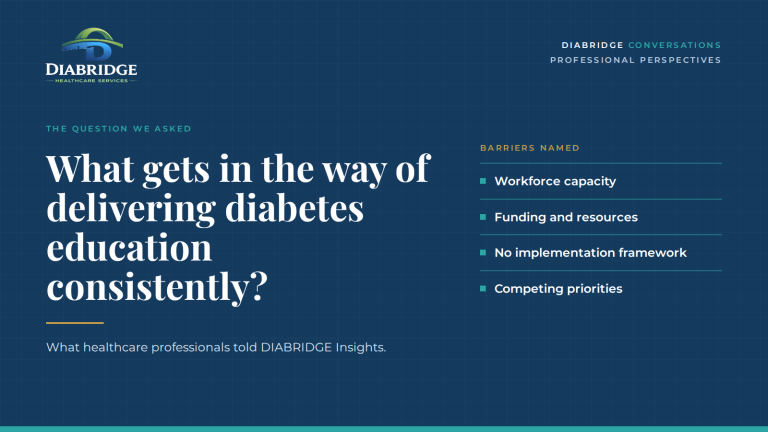
Through DIABRIDGE Conversations, the professional engagement series of DIABRIDGE Insights, we asked healthcare professionals one question, by LinkedIn poll and in direct conversation: what is the greatest barrier to delivering evidence-based diabetes education consistently?
Barriers practitioners selected (not ranked; the sample is too small for relative frequency to be meaningful):
- Workforce capacity
- Limited funding and resources
- No implementation framework
- Competing priorities
An earlier version of the question surfaced two further barriers: leadership priority and the lack of a standard framework.
Recurring themes from direct conversations
- Diabetes education is not consistently embedded as a routine clinical intervention.
- Clinicians lack protected time, structured resources and implementation support.
- Training alone is insufficient without governance, accountability and follow-up.
- Sustained delivery requires organisational commitment rather than reliance on individual champions.
The pattern is consistent. Every barrier practitioners named concerns an organisation’s capacity and structure to deliver education, not its knowledge of what good education looks like. Each maps directly onto one or more of the five conditions set out in Section 5.
- Workforce capacity → Workforce capability; protected delivery time
- Limited funding and resources → Ownership: a named lead who holds the resource
- No implementation framework → Governance and quality assurance; evidence of delivery
- Competing priorities → Ownership: education reported through clinical governance
- Leadership priority → Ownership at organisational level
These are exploratory findings from a small, self-selected sample of professionals reached through LinkedIn and professional networks. They are presented as thematic, not statistical, and are not ranked or quantified for that reason. They are reported because they agree with the published evidence, not in place of it.
04. Africa’s reality: the same gap, at greater scale
If the gap persists in a health system with a national audit, a quality standard and named programmes, it is wider where those scaffolds are thinner. Across much of Africa, the conditions that make structured education necessary are more acute, and the conditions that make it deliverable are weaker.
Africa at a glance
- +142%: projected rise in adults with diabetes, IDF Africa Region, 2024–2050 (24.6m to 59.5m)
- 72.6%: of adults with diabetes in the region estimated to be undiagnosed
- ~30%: of people with type 2 diabetes studied in sub-Saharan Africa achieve good glycaemic control
- About 1 in 3: facilities surveyed across Africa had short-acting insulin; about 1 in 4 offered HbA1c testing
- 46%: of the health workers the WHO African Region needs (2024)
- 1%: of global diabetes-related health expenditure, for 11.4% of people with diabetes worldwide
The burden is rising faster than anywhere else. The IDF Diabetes Atlas (11th edition) estimates 24.6 million adults living with diabetes in its Africa Region in 2024, projected to reach 59.5 million by 2050: a 142% increase, the highest of any IDF region. In Nigeria the number is projected to rise from 3.0 million to 6.6 million, and in the Democratic Republic of the Congo from 2.9 million to 7.3 million. The region is home to 11.4% of people with diabetes worldwide but receives about 1% of global diabetes-related health expenditure.
Most people are not yet in care, and most in care are not at target. An estimated 72.6% of adults with diabetes in the region are undiagnosed, the highest proportion of any IDF region. Among those diagnosed, a meta-analysis of 74 studies across sub-Saharan Africa (21,133 people with type 2 diabetes) found that only around 30% achieved good glycaemic control. The factors linked with good control included diabetes health literacy, dietary adherence, attendance at follow-up and medication adherence: precisely what structured education is designed to build.
Medicines and monitoring cannot be taken for granted. A 2022 meta-analysis of 21 studies across Africa found short-acting insulin available in about a third of facilities surveyed, metformin in fewer than half, and HbA1c testing in about a quarter. Short-acting insulin cost a median of around seven days’ wages. Where supply and monitoring are inconsistent, people carry more of their diabetes management themselves: adjusting food, recognising warning signs, and knowing when to seek help. Self-management knowledge becomes more important, not less.
The workforce is stretched. The WHO Regional Office for Africa reports that the region had 5.72 million health workers in 2024, only 46% of those it needs, with a projected shortage of 5.85 million by 2030. At the same time, an estimated 943,000 trained health workers were unemployed. Structured education cannot depend on scarce specialists. It has to be built into the existing workforce, with enough depth to survive migration and attrition.
Education is often the least structured part of care. An audit of diabetes self-management education programmes in South Africa found education was rarely adequately addressed in national policy and guidance, and was delivered mainly on an ad hoc basis, with few structured programmes in place. Research from the EXTEND programme in Lilongwe and Maputo concluded that these systems need integrated, dedicated diabetes services, with culturally adapted self-management education and training across every profession involved in diabetes care.
Yet education works in African settings. A 2025 meta-analysis of 17 randomised trials in Africa (3,730 participants) found self-management education reduced HbA1c by around 1.02 percentage points compared with usual care. A second 2025 meta-analysis of 19 studies in the WHO African Region (3,759 participants) also found a significant overall effect, although only nine of the nineteen studies reported significant results individually: effectiveness varies with how programmes are designed and delivered. A multicentre randomised trial in two urban Ghanaian hospitals has added to this local evidence base.
Lasting benefit is less certain. A 2024 review of self-management interventions for type 2 diabetes in sub-Saharan Africa found a significant pooled reduction in HbA1c at six months, but not at twelve months. The review does not establish why, and it should not be read as proof that benefit fades when delivery stops. It does mean that lasting effect cannot be assumed. For leaders, the practical question is not only whether education can work in Africa, but whether programmes are designed, resourced and measured to sustain their effect.
The implication is direct. Where the specialist workforce is thinner and turnover higher, an unowned programme does not decline slowly. It disappears with the person who was carrying it. Local adaptation to food, language, fasting practice, family context and health literacy is not a courtesy; it is a condition of education being used at all. And sustained, measured delivery, not initial effect alone, is the test leaders should apply to any structured education programme.
05. Five conditions for routine delivery
The conditions below are not specific to any one programme. They are what any organisation needs in place, whichever structured education it chooses. Most are already anchored in NICE NG28. What is usually missing is not the standard, but the organisational structure that makes someone responsible for meeting it.
1. Ownership. A named, accountable lead at organisational level, with structured education reported through clinical governance like any other service standard. Anchored in: NG28 asks organisations to resource educators and give them time: a duty that needs an owner.
2. Workforce capability. Trained, assessed professionals in defined roles, with enough depth that delivery survives staff turnover. Anchored in: NG28 requires delivery by trained, competent educators.
3. Governance and quality assurance. Defined scope of practice, escalation pathways, documentation standards and periodic quality review. Anchored in: NG28 requires programmes to be quality assured and independently reviewed.
4. Local adaptation. Education adapted to local food, language, health literacy, fasting practice and family context, while core clinical standards are held. Anchored in: NG28 requires programmes that suit the needs of the person; EXTEND calls for culturally adapted education.
5. Evidence of delivery. Offer, attendance and completion recorded and reviewed routinely, so the organisation can say how many people received education. Anchored in: NG28 requires outcomes to be audited regularly; the NDA shows what happens when recording is incomplete.
Ownership is a governance decision, not a training decision. Accountability has to come before programme selection.
06. Six questions for leaders
These questions are designed to be answered quickly, by a medical director, nursing lead or service manager, without commissioning a review.
- Who, by name, is accountable for structured diabetes education in this organisation?
- If our most experienced educator left tomorrow, would delivery continue next month?
- How many people were offered structured education last year, and how many completed it?
- Do those delivering education have a defined scope of practice and escalation pathway?
- Has our education been adapted to the food, language and daily lives of the people we serve?
- Where does structured education appear in our governance and quality reporting?
An organisation that cannot answer several of these has an ownership gap, whatever its policy documents say.
07. What happens next
DIABRIDGE Insights is now testing these questions across institutions through the Institutional Diabetes Education Leadership Survey 2026. It asks clinical and organisational leaders how structured diabetes education is owned, delivered, governed and evidenced in their settings. It takes around five minutes, and responses are anonymous.
Findings will inform a future Executive Brief, giving leaders a benchmark against peers rather than against guidance alone.
Take part: https://forms.cloud.microsoft/r/gWMuzXVb1J
About the author
Dorathy is a UK-based Senior Diabetes Specialist Nurse and Independent Prescriber with an MSc in Public Health. Her work spans specialist diabetes care, structured diabetes education and healthcare professional development.
About DIABRIDGE
DIABRIDGE Healthcare Services Ltd is a UK-registered healthcare implementation organisation. It works with hospitals, health systems and partners to embed structured diabetes education into routine care, bringing together workforce capability, clinical governance, locally adapted delivery and digital oversight. Its flagship implementation system is T2DM CORE™. DIABRIDGE Insights is its research and thought-leadership arm.
Evidence cited
- Sun J, Fan Z, Kou M, Wang X, Yue Z, Zhang M. Frontiers in Public Health. 2025;13:1622988. Meta-analysis of eight randomised trials of nurse-led diabetes self-management education. doi.org/10.3389/fpubh.2025.1622988
- National Institute for Health and Care Excellence. Type 2 diabetes in adults: management (NG28), recommendations 1.2.1–1.2.3.
- NHS England Digital. National Diabetes Audit, Core Report 1: Care processes and treatment targets, 2024–25. Published 12 February 2026. digital.nhs.uk/…/national-diabetes-audit
- NHS England Digital. National Diabetes Audit commentary on the recording of structured education attendance.
- International Diabetes Federation. IDF Diabetes Atlas, 11th edition. 2025. Africa Region and country data.
- Fina Lubaki JP, Omole OB, Francis JM. Diabetology & Metabolic Syndrome. 2022;14:134. Meta-analysis of glycaemic control among people with type 2 diabetes in sub-Saharan Africa, 2012–2022.
- Kibirige D, Olum R, Kyazze AP, Bongomin F, Sanya RE. Tropical Medicine & International Health. 2022;27(11):942–960. Availability and affordability of essential diabetes medicines and diagnostic tests in Africa.
- WHO Regional Office for Africa. Health workforce report, May 2026: workforce size, needs-based shortage and unemployment in the African Region.
- Dube L, Van den Broucke S, et al. Journal of Public Health Research. 2015;4(3):581. Audit of diabetes self-management education programmes in South Africa.
- Bamuya C, Correia JC, et al. BMC Public Health. 2021;21:1355. EXTEND programme, Lilongwe and Maputo.
- Peprah Osei E, Ekpor E, Akyirem S, Asante A, Romadlon DS. Annals of Medicine & Surgery. 2025;87(7):4476–4483. Meta-analysis of 17 randomised trials of diabetes self-management education in Africa.
- Yimer SS, Addissie A, Kidane EG, Reja A, Abdela AA, Ahmed AA. Frontiers in Clinical Diabetes and Healthcare. 2025;6:1554524. Meta-analysis of self-management education and support in the WHO African Region. doi.org/10.3389/fcdhc.2025.1554524
- Carter N, Nalbant G, Chahal P, Chattopadhyay K. JBI Evidence Synthesis. 2024;22(9):1715. Review of self-management interventions for type 2 diabetes in sub-Saharan Africa. eprints.whiterose.ac.uk/id/eprint/218252
- DIABRIDGE Insights. DIABRIDGE Conversations: professional engagement through LinkedIn polling and direct conversations with healthcare professionals. 2026. Exploratory; unpublished.
- Lamptey R, Amoakoh-Coleman M, et al. BMC Health Services Research. 2023;23:199. Multicentre randomised trial in two urban Ghanaian hospitals.
About this brief
Published figures in this brief have been checked against primary sources. Findings from DIABRIDGE Conversations (LinkedIn polling and direct professional conversations, 2026) are exploratory, drawn from a small self-selected sample, and presented as thematic rather than statistical. This brief is for healthcare leaders and professionals; it is not clinical guidance or individual medical advice. DIABRIDGE Healthcare Services Ltd is an independent organisation and is not affiliated with, commissioned by or endorsed by the NHS. NHS data are cited from public publications, and references to UK clinical experience describe the author’s professional background.
Suggested citation: Oparaeche D. The Implementation Gap: Structured Diabetes Education. DIABRIDGE Insights Executive Brief 01. DIABRIDGE Healthcare Services Ltd; September 2026.
Related Insights
-
Conversations
What gets in the way of delivering diabetes education consistently?
Our first DIABRIDGE Conversation asked healthcare professionals one question: what is the greatest barrier to delivering evidence-based diabetes education consistently? Their answers informed DIABRIDGE Insights Executive Brief 01.
Read about What gets in the way of delivering diabetes education consistently?
-
Forum
DIABRIDGE Forum: Structured Diabetes Education
The inaugural DIABRIDGE Forum brought healthcare professionals together to discuss structured diabetes education. They highlighted a lack of diabetes educators, limited clinical time, and the barriers of medicine access and cost, and were clear that structured education would benefit their patients.
View Forum about DIABRIDGE Forum: Structured Diabetes Education