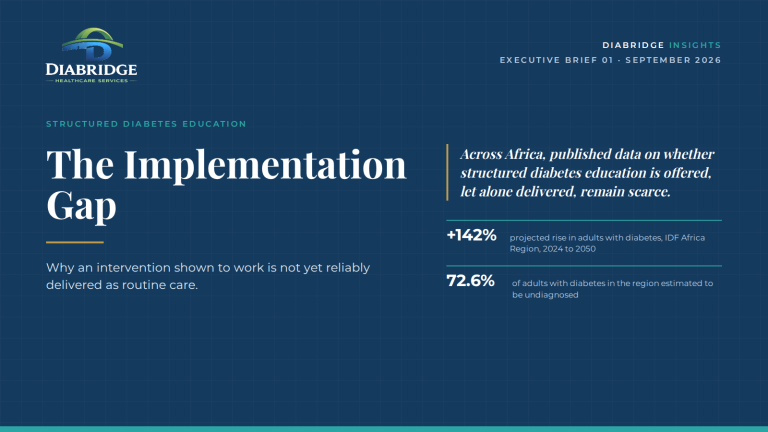
Our first DIABRIDGE Conversation asked healthcare professionals one question: what is the greatest barrier to delivering evidence-based diabetes education consistently? Their answers informed DIABRIDGE Insights Executive Brief 01.
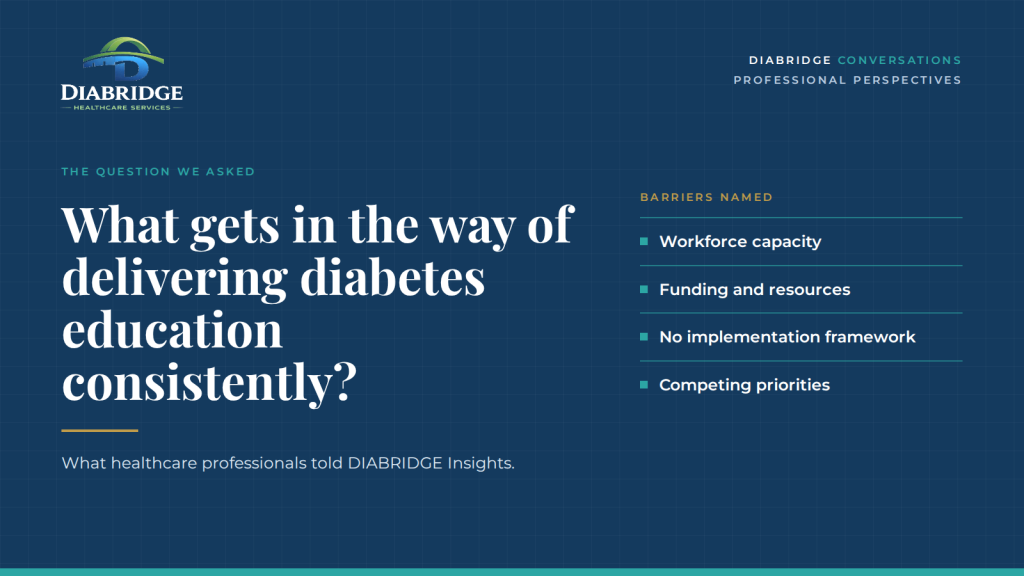
DIABRIDGE Conversations is the professional engagement series of DIABRIDGE Insights. Our first Conversation asked healthcare professionals, through a LinkedIn poll and in direct conversation, one question: what is the greatest barrier to delivering evidence-based diabetes education consistently?
What practitioners told us
The barriers selected were workforce capacity, limited funding and resources, the lack of an implementation framework, and competing priorities. An earlier version of the question also surfaced leadership priority and the lack of a standard framework.
In direct conversations, four themes recurred:
- Diabetes education is not consistently embedded as a routine clinical intervention.
- Clinicians lack protected time, structured resources and implementation support.
- Training alone is insufficient without governance, accountability and follow-up.
- Sustained delivery requires organisational commitment rather than reliance on individual champions.
What it means
Every barrier named concerns an organisation’s capacity and structure to deliver education, not its knowledge of what good education looks like. These findings informed DIABRIDGE Insights Executive Brief 01, The Implementation Gap, which maps each barrier to five conditions for routine delivery.
About these findings: they are exploratory, drawn from a small self-selected sample of professionals, and presented as themes rather than statistics.
Share your perspective
If you lead or support diabetes services, take part in the Institutional Diabetes Education Leadership Survey 2026. It takes around five minutes, and responses are anonymous.
Related Insights
-
Forum
DIABRIDGE Forum: Structured Diabetes Education
The inaugural DIABRIDGE Forum brought healthcare professionals together to discuss structured diabetes education. They highlighted a lack of diabetes educators, limited clinical time, and the barriers of medicine access and cost, and were clear that structured education would benefit their patients.
View Forum about DIABRIDGE Forum: Structured Diabetes Education
-
Executive Brief
The Implementation Gap: Structured Diabetes Education
Structured diabetes education improves outcomes, including in African trials, yet it is not reliably delivered as routine care, and published data on its reach are scarce. This brief sets out why the implementation gap forms, why it matters most in Africa, and five conditions organisations need for reliable, sustained delivery.
Read about The Implementation Gap: Structured Diabetes Education