The Bridge Edition 02
Executive briefing for diabetes leadership
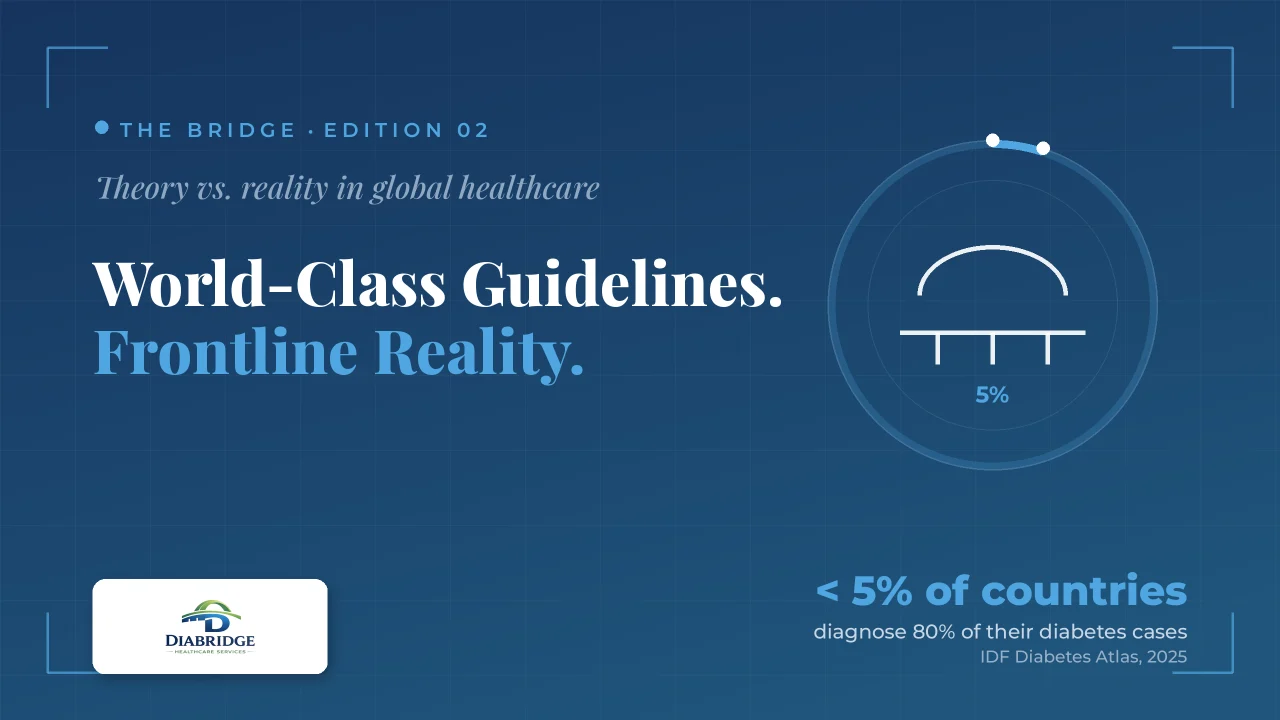
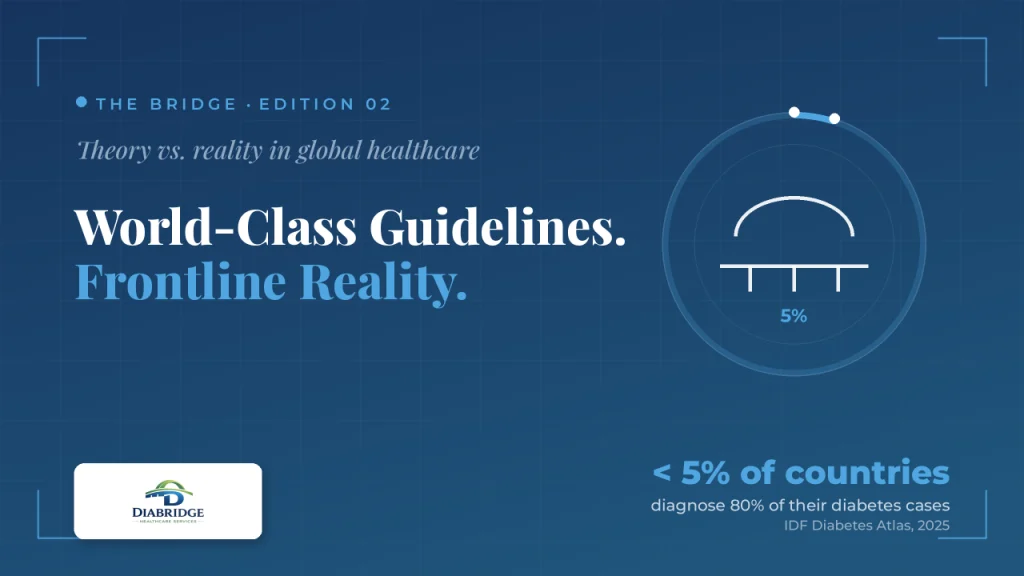
Clinical guidelines provide an evidence-based destination, but frontline teams need practical ways to navigate the journey. This edition explores the gap between global guidance and everyday diabetes care-and what it takes to bridge it.
Last month, we looked at why “just stop eating rice” is a lazy, restrictive non-plan for diabetes care.
The feedback from many of you was immediate: we see this kind of advice given all the time.
It points directly to a much larger, systemic issue that every healthcare leader must face: the massive chasm between healthcare theory and frontline reality.
Clinical guidelines provide an evidence-based destination. Frontline teams still need practical ways to navigate the journey. The distance between evidence and execution is where patient outcomes are won or lost.
Theory vs. reality
Look at how this theory vs. reality gap plays out on a global scale.
High-income systems: evidence vs. adaptation
In many high-income health systems, clinicians work within robust, evidence-based frameworks. The challenge is rarely the quality of the guidance; it’s translating that evidence into care plans that fit a patient’s culture, health literacy, and financial reality.
A guideline may recommend precise carbohydrate counting, but what does that mean for a grandmother buying food from a roadside market where nothing has a nutrition label?
Developing landscapes: international guidance vs. resource constraints
Many health systems adopt internationally recognised clinical guidance, but implementation is heavily constrained by workforce shortages, limited diagnostics, fragmented services, or insufficient funding.
The theory is world-class; the reality is a resource vacuum.
The starkest gap: no pathway at all
In many rural or underfunded facilities, the contradiction deepens: they don’t have formalised clinical pathways at all.
Clinicians are left entirely to their own devices, forced to improvise care from scratch, leading to wildly inconsistent patient outcomes and immense professional burnout.
The distance between evidence and execution is where patient outcomes are won or lost.
Bridging evidence and everyday practice
Whether a health system is heavily bound by rigid guidelines or completely lacking a structured pathway, the fundamental failure is identical.
The challenge isn’t a lack of clinical evidence. It is the absence of a bridge that translates evidence into practical, culturally relevant action for the clinicians delivering care every day.
Clinical guidelines alone don’t improve outcomes. Clinicians who can translate them into everyday practice do.
If we want better outcomes, we have to stop designing care pathways for a perfect world that doesn’t exist.
The reality check
This month, take a hard look at your own care pathways, patient advice, or training materials and force a reality check:
“Is this instruction designed for a sterile textbook scenario, or does it actively account for the patient’s actual environment, limitations, and culture?”
If it doesn’t bridge the gap between theory and reality, it isn’t a care pathway – it’s an aspiration.
Let’s build the bridge
Where do you see the greatest disconnect between clinical guidance and everyday practice?
Explore our implementation approach →
Until next month,
Dorathy Oparaeche
Founder & Clinical Lead
DIABRIDGE Healthcare Services
Bridging global standards to local care
Sources
Sources and further reading
- International Diabetes Federation (2025).
IDF Diabetes Atlas, 11th edition.
Global and regional estimates of diabetes prevalence and undiagnosed diabetes.
Global, Regional, and National Estimates of Undiagnosed Diabetes in Adults: Findings From the 2025 IDF Diabetes Atlas.
Diabetes Care (2026).
Source for the cover statistic: fewer than 5% of countries and territories reached the target of diagnosing at least 80% of people with diabetes.- World Health Organization (2020).
WHO package of essential noncommunicable (PEN) disease interventions for primary health care.
Practical guidance for delivering essential care in resource-limited settings.
The Bridge is intended for healthcare professionals and organisations. It provides general information and does not constitute individual medical advice.
Subscribe to The Bridge
A short email each month when a new edition is published, with a link to read it in full.
Related Insights
-
The Bridge
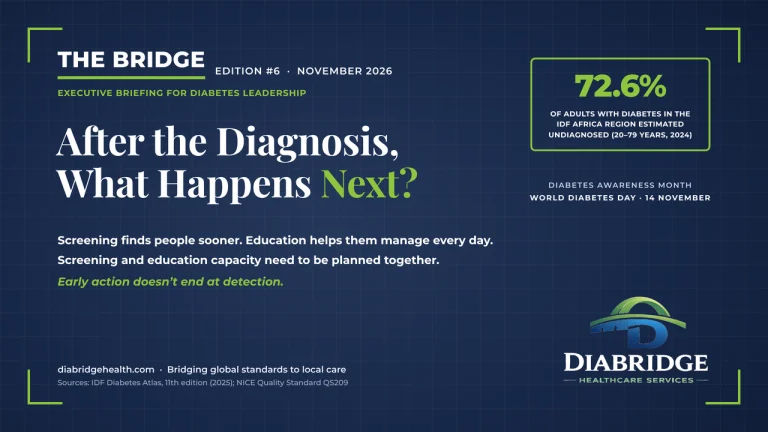
After the Diagnosis, What Happens Next?
Early action doesn’t end at detection. Why screening and structured diabetes education must be planned together.
-
The Bridge
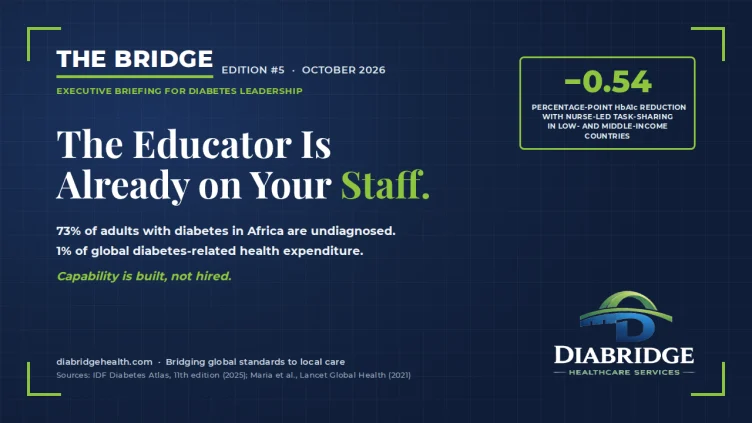
The Educator Is Already on Your Staff
The educator your hospital needs may already be on your staff. This edition explores how structured training, supervision and clear accountability can build diabetes education capability within existing teams.
-
Conversations
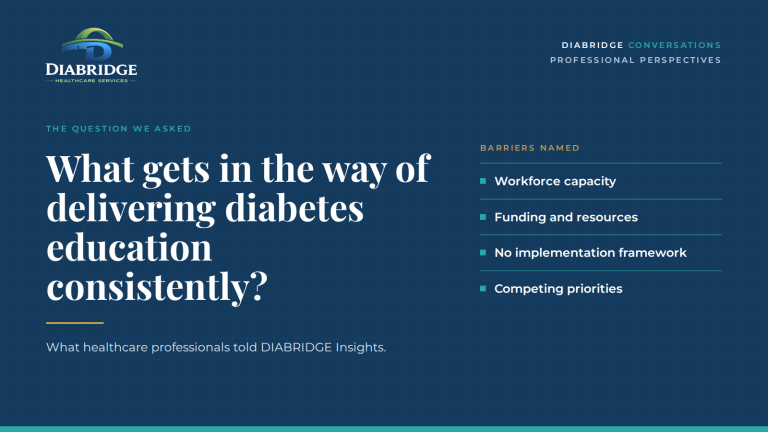
What gets in the way of delivering diabetes education consistently?
Our first DIABRIDGE Conversation asked healthcare professionals one question: what is the greatest barrier to delivering evidence-based diabetes education consistently? Their answers informed DIABRIDGE Insights Executive Brief 01.
Read about What gets in the way of delivering diabetes education consistently?