The Bridge Edition 06
Executive briefing for diabetes leadership
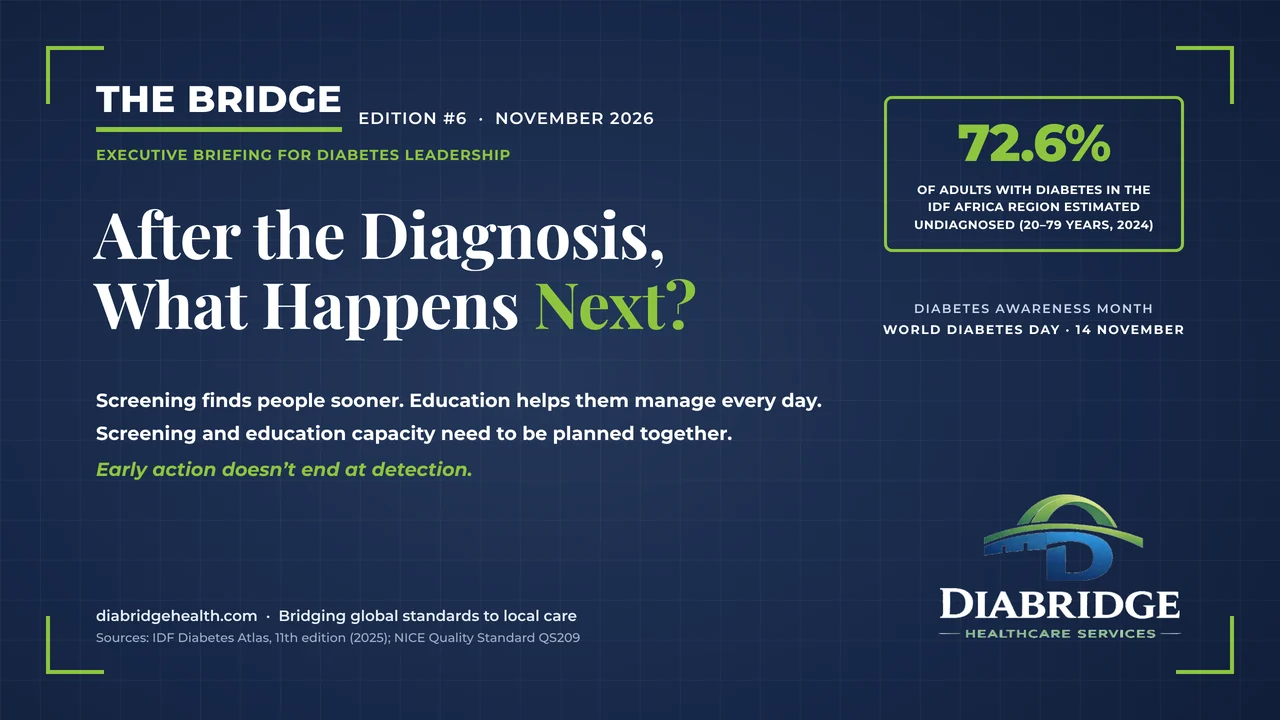
Early action doesn’t end at detection. Why screening and structured diabetes education must be planned together.
Early action doesn’t end at detection.
Dorathy Oparaeche
Founder and Clinical Lead, DIABRIDGE
1 November 2026
Detection is where early action begins
November is Diabetes Awareness Month, and 14 November marks World Diabetes Day, an opportunity to strengthen early diagnosis, access to comprehensive care and efforts to address diabetes stigma.
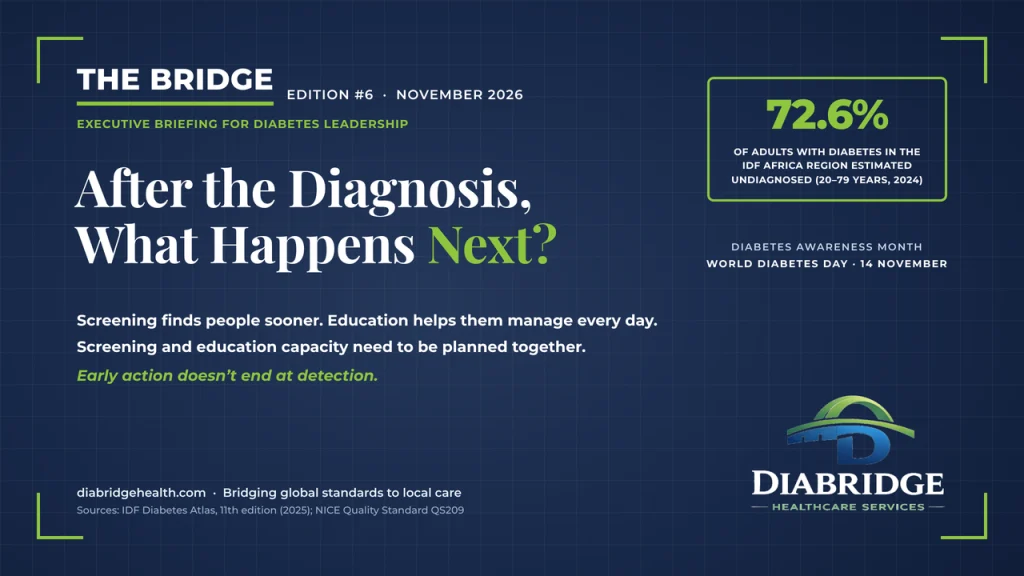
The case for earlier detection is strong. In the IDF Africa Region, an estimated 72.6% of adults aged 20–79 living with diabetes were undiagnosed in 2024. Every screening campaign that closes part of that gap deserves support.
But detection only starts the process. A diagnosis enables treatment and access to care. Structured education helps people build the knowledge, skills and confidence to manage the condition every day.
If we invest in finding people sooner without planning what follows, we leave an essential part of early action unfinished.
The first 90 days: an audit window
The first 90 days after diagnosis give leaders a useful window to examine. It is not a clinical deadline. It is a practical way to ask what a newly diagnosed patient actually receives.
Trace that period for a typical patient in your service:
- Were they offered structured education, or a leaflet and a follow-up appointment?
- How many days passed before their first education session?
- Who delivered it, and to what standard?
- Was attendance recorded and followed up?
- Could the patient explain their medicines, monitoring plan and warning signs at the end?
If your institution tracks screening activity, can it also trace the patient’s journey from diagnosis into education?
Who is accountable?
In Edition 04, we asked who inside the hospital owns structured diabetes education. This month, the question is narrower and more demanding:
Who is accountable for moving a newly diagnosed patient into structured diabetes education?
In many services, several people play a part. The diagnosing clinician, the clinic nurse, the dietitian and the pharmacist all contribute something. But contributing is different from being accountable.
If no named role is responsible for the referral, the booking and the follow-up, patients fall into the gaps between those roles.
Leaders should be able to answer this question by naming a role, not a department.
What structured education has to cover
In our first edition, we argued that “just stop eating rice” is not a diabetes plan. The same applies here. A newly diagnosed patient needs more than a list of foods to avoid.
Structured education should cover what people actually ask in the weeks after diagnosis:
- Food: adapting familiar meals to individual needs and circumstances.
- Medicines: what each one does, when to take it and what to do if a dose is missed.
- Monitoring: whether monitoring is needed, what results mean and when to act.
- Warning signs: recognising low or high glucose where relevant, sick-day actions and when to seek help.
- Daily life: work, travel, fasting, illness and family responsibilities.
This is a curriculum, and it needs to be delivered by someone trained to deliver it.
Potential is not the same as readiness
Last month, we argued that the educator is often already on your staff. Experienced nurses can bring valuable clinical knowledge and established patient relationships. Their readiness to deliver structured education still needs to be assessed and developed.
But having nurses on staff does not automatically create an education service. Their potential becomes delivery capacity only when four conditions are in place:
- Training and competency: educators are prepared and assessed to deliver the programme.
- Protected time: education is part of planned service delivery rather than an additional informal duty.
- Appropriate resources: staff have a structured curriculum, teaching materials and clear clinical escalation guidance.
- A defined pathway: referral, scheduling, attendance and follow-up responsibilities are established.
If any one of these is missing, education depends on individual goodwill. That may work for a while, but it rarely lasts.
Plan screening and education together
The central point of this edition is simple: screening capacity and education capacity need to be planned together.
When screening expands without corresponding education capacity, services risk longer waits and missed opportunities to support self-management. Planning both together helps patients benefit from earlier diagnosis.
This World Diabetes Day, I would invite every hospital and health system leader to do one thing: review what a newly diagnosed patient in your service receives in their first 90 days.
Then ask yourself one question:
If screening doubled tomorrow, who would educate those patients?
If you would like to share how your institution approaches this, the DIABRIDGE Insights Institutional Diabetes Education Leadership Survey 2026 is open. Your answers will shape what we report back to the field.
Take part in the Institutional Diabetes Education Leadership Survey 2026 →
Dorathy Oparaeche
Founder and Clinical Lead
DIABRIDGE Healthcare Services Ltd
The Bridge is DIABRIDGE’s monthly executive briefing for diabetes leadership.
Bridging global standards to local care · diabridgehealth.com
Sources
International Diabetes Federation (2025). IDF Diabetes Atlas, 11th edition. Africa Region: 72.6% of adults aged 20–79 with diabetes estimated undiagnosed in 2024. https://diabetesatlas.org/
World Health Organization (2026). World Diabetes Day: Early action on diabetes. https://www.who.int/campaigns/world-diabetes-day
National Institute for Health and Care Excellence (NICE). Quality Standard QS209, Statement 2: Structured education programme. https://www.nice.org.uk/guidance/qs209
The Bridge is intended for healthcare professionals and organisations. It provides general information and does not constitute individual medical advice.
Subscribe to The Bridge
A short email each month when a new edition is published, with a link to read it in full.
Related Insights
-
The Bridge
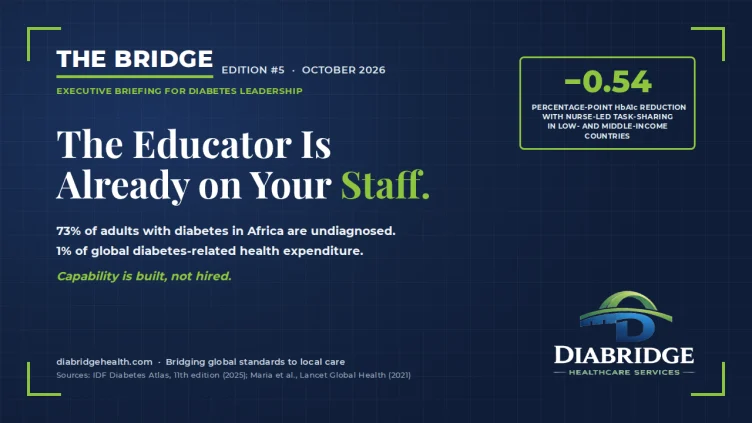
The Educator Is Already on Your Staff
The educator your hospital needs may already be on your staff. This edition explores how structured training, supervision and clear accountability can build diabetes education capability within existing teams.
-
The Bridge
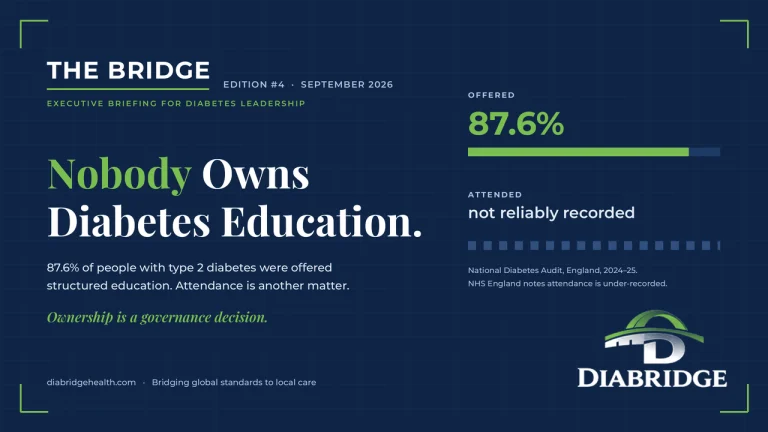
Nobody Owns Diabetes Education.
87.6% of people with type 2 diabetes in England were offered structured education. Attendance is another matter.
-
Conversations
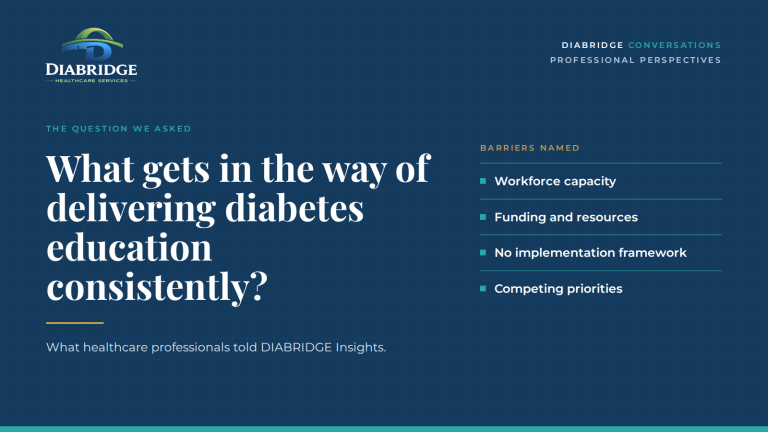
What gets in the way of delivering diabetes education consistently?
Our first DIABRIDGE Conversation asked healthcare professionals one question: what is the greatest barrier to delivering evidence-based diabetes education consistently? Their answers informed DIABRIDGE Insights Executive Brief 01.
Read about What gets in the way of delivering diabetes education consistently?