The Bridge Edition 04
Executive briefing for diabetes leadership
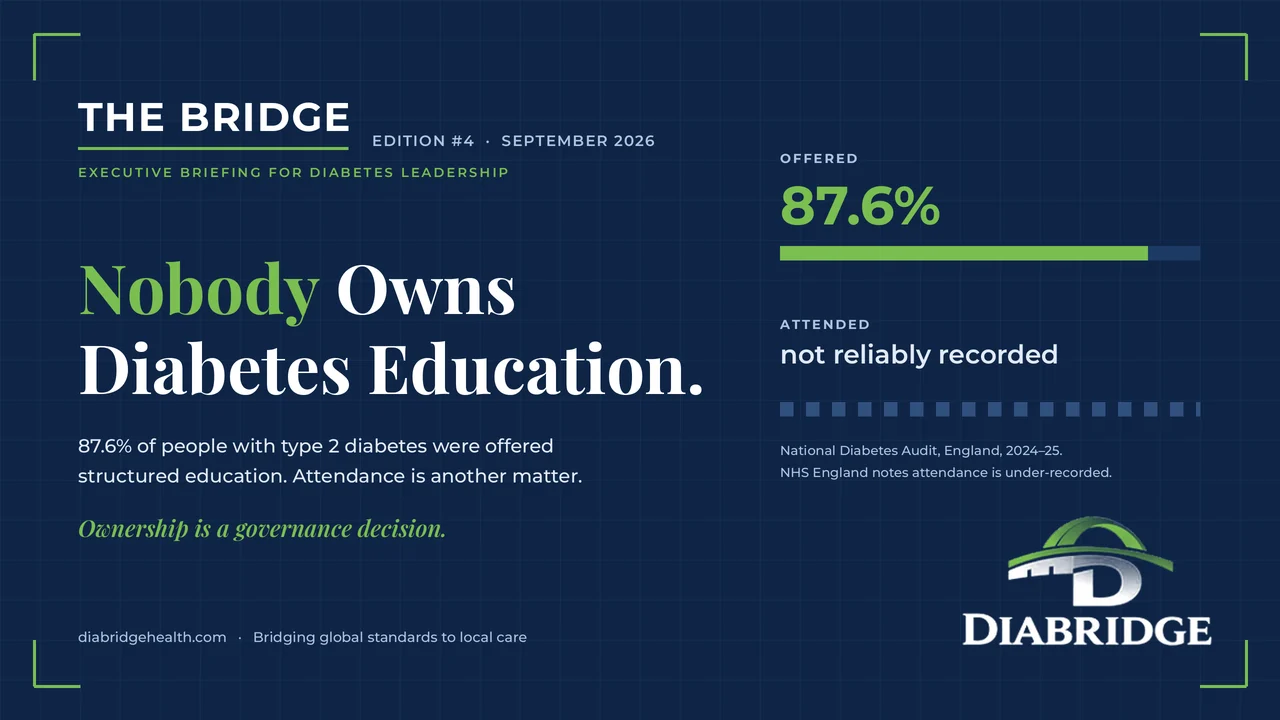
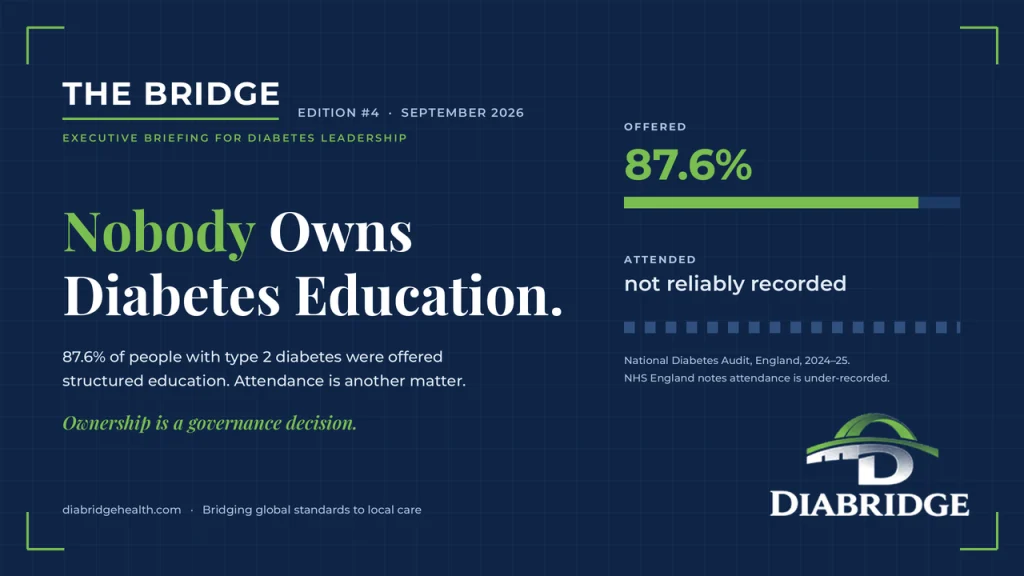
87.6% of people with type 2 diabetes in England were offered structured education. Attendance is another matter.
Editor’s Perspective
Every diabetes strategy I have read names education as a pillar. Every guideline recommends it. Ask a hospital whether structured diabetes education matters and you will get agreement in about two seconds.
Ask who is accountable for delivering it and the room goes quiet.
Let me be precise about what I am claiming, because the title is deliberately blunt. I am not saying nobody delivers diabetes education. Thousands of healthcare professionals deliver it every day, frequently alongside competing clinical responsibilities. I am saying that it can become organisationally orphaned. Responsibility gets spread across several professional groups, and none of them holds explicit accountability for whether it actually happens, to whom, and to what standard.
Distributed responsibility is not the same thing as shared accountability. One describes who contributes. The other describes who answers.
That is the difference between a programme that exists on paper and one that exists in practice.
The conversation everyone recognises
Diabetes education sits between services. Endocrinology contributes. Specialist nursing contributes. Dietetics contributes. Outpatients hosts it. Primary care refers into it. Pharmacy reinforces it. From the outside this looks like good collaborative practice.
A patient is discharged after an admission involving poor glycaemic control. Someone asks whether they have had structured education. The ward nurse assumes the specialist team covered it. The specialist team assumes it was arranged at diagnosis. The clinic assumes primary care referred. Primary care has a record of an offer made eighteen months ago and nothing about what happened next.
Nobody in that conversation is negligent. Nobody is under-motivated. Every one of them is doing the job they understand to be theirs. The education still did not happen, and more tellingly, nobody in the room can say so with certainty.
Why the gap forms
This is a design problem, not a motivation problem. Education rarely appears in a job description as an accountability. It appears as an activity, and activities get absorbed into whatever else the week demands. It usually has no budget code, so it has no protected time, no cover arrangement and no succession plan. When staffing tightens, it is the first thing to compress, and it compresses quietly because nothing formally records that it has. And it rarely has an audit line, so it stays invisible to the mechanisms institutions use to notice that something has gone wrong.
An intervention that is universally endorsed but structurally unowned will drift toward non-delivery. Not because anyone decided against it, but because nothing in the system is built to notice its absence.
What it costs the institution
The cost is not confined to patient outcomes. Clinical time is spent repeatedly explaining the same fundamentals to the same patients. Referrals are made without any visibility of completion. Staff capability rises and falls with turnover, because capability lives in individuals rather than in a system. And leadership cannot distinguish between an intervention that was unavailable, one that was offered, and one that was actually delivered.
The result is operational variation that stays largely invisible, because it sits across departmental boundaries rather than inside any one of them.
Evidence in focus
It is tempting to argue that absent ownership directly causes admissions, insulin errors and avoidable complications. That claim outruns the evidence, and executives spot an overreach immediately. The more defensible argument is stronger anyway.
First, the intervention works. A 2025 meta-analysis of randomised trials found that nurse-led structured self-management education reduced HbA1c by around 0.92 percentage points at three to six months, with a reduction of around 0.54 percentage points sustained beyond six months. The authors rated the HbA1c evidence as moderate certainty, with substantial variation between trials and most studies conducted in Asia. The sensible interpretation is therefore the direction of effect, rather than treating the pooled estimate as a universal promise.
Second, the offer is nearly universal. The 2024–25 National Diabetes Audit reports that 87.6% of people with type 2 diabetes in England were offered structured education within twelve months of diagnosis. On the measure most visible to national reporting, the system looks like it is performing.
Third, delivery is where it is lost. The audit measures offer and attendance separately, and recorded attendance runs far below the offer rate. But the audit’s own commentary is the more important detail: NHS England notes that poor recording means the apparently low attendance rates are likely to be an underestimate. That caveat is usually read as a limitation of the data. Read it the other way. When a system cannot say with confidence how many people actually received the intervention it recorded offering, that is not only a data problem. It is an ownership problem showing up as a data problem.
So the honest formulation is this. Structured education improves outcomes. It is offered at scale. Recorded attendance remains substantially below recorded offers, while incomplete recording makes the true size of that gap difficult to establish.
The question for any board is not whether education works. It is who here is accountable for the distance between the offer and the delivery.
Numbers that matter
- 87.6%: of people with type 2 diabetes in England were offered structured education within 12 months of diagnosis. National Diabetes Audit, 2024–25.
- −0.92: percentage-point reduction in HbA1c at three to six months from nurse-led structured education, against usual care.
- 0–3 months: the window in which no significant effect was detectable. This is not a quick win.
- 0: of the eight pooled trials were conducted in Africa. Six were in Asia, two in Europe.
Does your institution own diabetes education?
Five questions a director can ask this week.
- A named accountable lead. Not necessarily a new post. Someone explicitly accountable for delivery, by name, who would be asked first if delivery failed.
- A defined education pathway and curriculum. What is delivered, to whom, at what point, and by whom.
- A competent delivery workforce. Training, competency records, and a way of maintaining capability as staff move on. Having trained people once is not evidence of ownership. It is one component of workforce capability.
- A place within clinical governance. Education appears in the diabetes pathway, in escalation arrangements and in quality oversight, not only in the strategy document.
- Measured and reported delivery. Reach, completion, quality and appropriate outcomes, visible to leadership at a defined interval.
An institution that can answer all five has the foundations of institutional ownership. An institution that cannot answer several of them has an ownership gap, whatever its policy documents say.
Around the world
I write this from specialist diabetes practice in the NHS, a system with a national audit, a quality standard and named programmes. The gap persists anyway.
Now consider a health system without those scaffolds. An audit of diabetes self-management education programmes in South Africa found that education is rarely adequately addressed in national policy and guidance, and is mainly delivered on an ad-hoc basis, with only a few structured programmes in existence. Work on the EXTEND programme in Lilongwe and Maputo concluded that what these systems need is integrated, dedicated diabetes services with culturally adapted education and training across all the professions involved in diabetes care. A 2026 scoping review of paediatric type 1 diabetes care across sub-Saharan Africa identified self-management education and staff training as core elements of the strategies that actually work.
The evidence gap is not the main constraint. The question of whether structured education transfers to a low-resource setting has been tested under randomised conditions in two urban Ghanaian hospitals, rather than assumed from high-income systems. What the pooled evidence still lacks is African trials at scale: none of the eight studies in the meta-analysis above were conducted on the continent.
The constraint is the same one described above, operating with less margin for error. In practical terms, where specialist workforces are thinner and turnover is higher, the risk is greater that an unowned programme disappears with the person who was carrying it.
Edition 03 argued that Africa’s diabetes decade has already begun. This is the part that decides whether the decade goes well. Not whether education is available, but whether anyone is accountable for it.
Looking ahead
Ownership is a governance decision, not a training decision.
The first question is not “Which programme should we implement?” It is: “Who is accountable for making sure education actually happens?”
DIABRIDGE Insights is now testing this question across institutions
The Institutional Diabetes Education Leadership Survey 2026 asks hospital and health system leaders how diabetes education is owned, governed and measured inside their institutions. It takes about five minutes, and responses are reported only in aggregate.
If you lead or deliver diabetes education, your response will contribute to DIABRIDGE Insights’ emerging evidence base on how institutions translate education from a recommended intervention into accountable delivery.
Take the Institutional Diabetes Education Leadership Survey 2026
Until next month.
Dorathy Oparaeche
Founder & Clinical Lead
DIABRIDGE Healthcare Services Ltd
Sources
- Sun J, Fan Z, Kou M, Wang X, Yue Z, Zhang M. Frontiers in Public Health. 2025;13:1622988.
- National Diabetes Audit Core Report 1, 2024–25. NHS England Digital, published 12 February 2026.
- NHS England Digital. National Diabetes Audit structured education commentary, on under-recording of attendance.
- Bamuya C, Correia JC, et al. BMC Public Health. 2021;21:1355. EXTEND programme, Lilongwe and Maputo.
- Djiofack Kentsop HB, Zarowsky C, von Oettingen JE. BMC Public Health. 2026;26:1968.
- Lamptey R, Amoakoh-Coleman M, et al. BMC Health Services Research. 2023;23:199.
- Dube L, Van den Broucke S, et al. Journal of Public Health Research. 2015;4(3):581.
Comparability note. The National Diabetes Audit reporting period changed from 15 months to 12 months in 2024–25; figures from 2024–25 onwards should not be treated as directly comparable with earlier periods.
The Bridge is intended for healthcare professionals and organisations. It provides general information and does not constitute individual medical advice.
Related Insights
-
Conversations
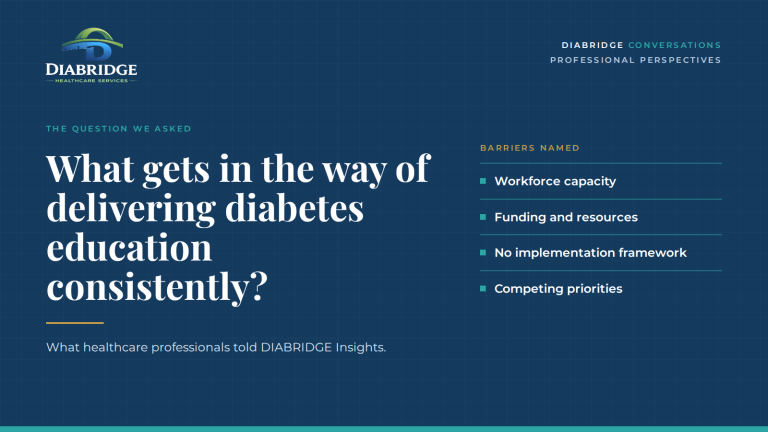
What gets in the way of delivering diabetes education consistently?
Our first DIABRIDGE Conversation asked healthcare professionals one question: what is the greatest barrier to delivering evidence-based diabetes education consistently? Their answers informed DIABRIDGE Insights Executive Brief 01.
Read about What gets in the way of delivering diabetes education consistently?
-
Forum
DIABRIDGE Forum: No Educator, No Education? Building Diabetes Education Capability Within Existing Teams
Many hospitals have few or no dedicated diabetes educators, and doctors have little time to teach. The next DIABRIDGE Forum asks how healthcare teams can build education capability within the staff they already have.
-
Forum
DIABRIDGE Forum: Structured Diabetes Education
The inaugural DIABRIDGE Forum brought healthcare professionals together to discuss structured diabetes education. They highlighted a lack of diabetes educators, limited clinical time, and the barriers of medicine access and cost, and were clear that structured education would benefit their patients.
View Forum about DIABRIDGE Forum: Structured Diabetes Education