The Bridge Edition 03
Executive briefing for diabetes leadership
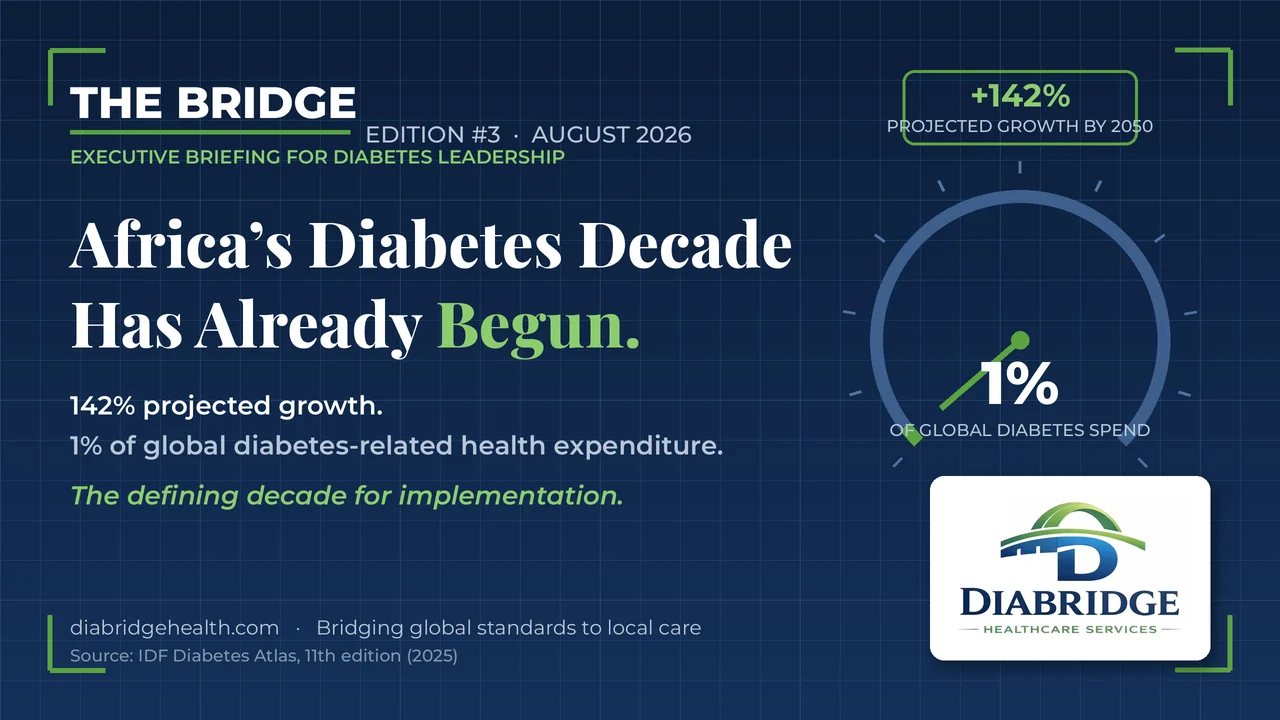
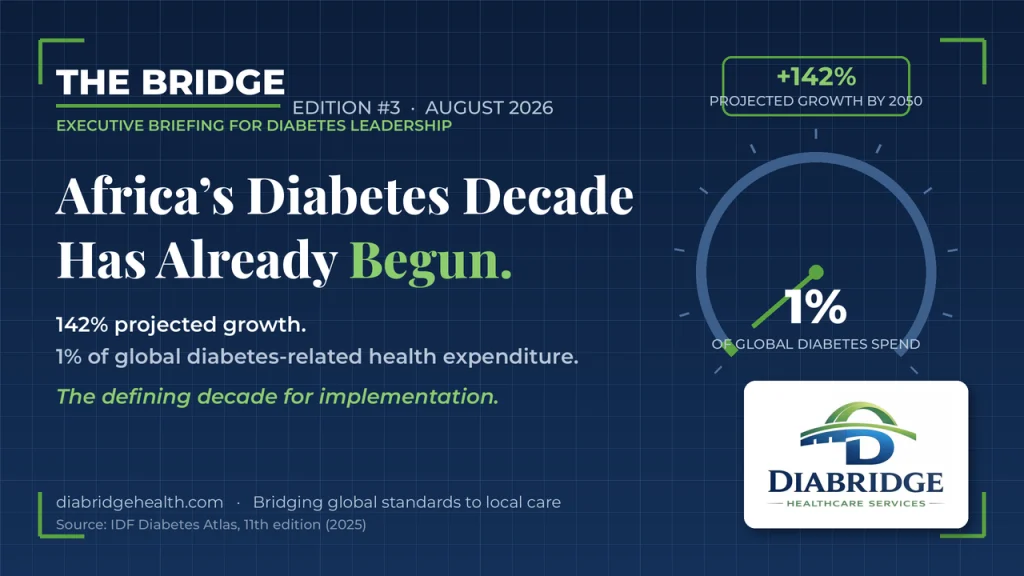
142% projected growth. Approximately 1% of global diabetes-related health expenditure. Africa’s defining decade for diabetes implementation has already begun.
THE BRIDGE · EDITION 03 · AUGUST 2026
Executive Briefing for Diabetes Leadership
142% projected growth. Approximately 1% of global diabetes-related health expenditure. The defining decade for implementation.
In This Edition
- Editor’s Perspective
- Cover Story
- What We’re Learning
- Evidence in Focus
- Numbers That Matter
- Around the World
- Looking Ahead
Editor’s Perspective
Dear colleague,
When I sat down to write this month’s edition, I kept returning to a habit I notice in almost every global health forum: Africa’s diabetes epidemic is discussed in the future tense. The projections are quoted, the warnings are issued and the response is deferred, as though the crisis were an event scheduled for 2050.
As a clinician, I cannot read the data that way. The people who will make up the projected 60 million are not hypothetical future patients. Many are already in clinics, markets, antenatal wards and workplaces today—most without a diagnosis. What we choose to implement in this decade will decide what the next one looks like.
That is why this edition makes a deliberate shift: from describing the gap, as we did in Editions 01 and 02, to defining the decade of work required to close it.
I hope this edition is useful to you, and I would genuinely value hearing what the diabetes decade looks like from where you stand.
Dorathy Oparaeche
Founder & Clinical Lead
DIABRIDGE Healthcare Services
Cover Story
Africa’s Diabetes Decade Has Already Begun
According to the IDF Diabetes Atlas (11th Edition, 2025), the number of adults living with diabetes in the IDF Africa Region is projected to increase by 142%, reaching approximately 60 million people by 2050—the highest projected increase of any region.
Yet the projection is not the story.
The story is what is already happening today.
Diagnosis: 73%
Approximately 73% of adults living with diabetes remain undiagnosed—around three in four people, representing the highest proportion of any region globally.
Health Expenditure: USD 10 billion
Africa accounts for approximately 1% of global diabetes-related health expenditure, the lowest share of any region despite carrying one of the world’s fastest-growing diabetes burdens.
Diabetes was responsible for an estimated 216,000 deaths across the region in 2024.
The complications that will dominate clinic workloads in 2040 are already being seeded today in patients who have never had a blood glucose test.
The interventions that will change the picture in 2050 are those implemented during this decade.
Can healthcare systems close the gap?
Five implementation priorities
1. Diagnose earlier
No strategy survives a 73% undiagnosed rate. Health systems must make screening routine wherever adults already interact with care.
2. Strengthen primary care
No healthcare system can specialist-refer its way through a 142% increase in the number of adults living with diabetes.
3. Build realistic supply chains
Design care around the medicines, diagnostics and technologies that are consistently available—not the ideal system that may not yet exist.
4. Grow the workforce
Structured task-sharing and workforce development transform scarce expertise into system-wide capability.
5. Design culturally appropriate care
Care that reflects local food, language, culture and community is not simply good communication—it is good clinical practice.
What We’re Learning
From DIABRIDGE Conversations
One consistent message continues to emerge from conversations with healthcare professionals across Africa and the wider diaspora.
The appetite is no longer for greater awareness.
The demand is for implementable structure.
Healthcare professionals are asking practical questions:
- How do we establish structured diabetes education?
- What does an effective facilitator pathway look like?
- How can programmes be adapted to local contexts?
To better understand current practice, we are conducting the Institutional Diabetes Education Leadership Survey 2026.
The survey explores how structured diabetes education is—or is not—being delivered across healthcare institutions.
Findings will be published later this year in a DIABRIDGE Insights Executive Report and shared first with participants.
Take part in the Institutional Diabetes Education Leadership Survey 2026 →
Evidence in Focus
1 in 7
An estimated one in seven live births within the IDF Africa Region is affected by hyperglycaemia during pregnancy.
Source: IDF Diabetes Atlas (11th Edition, 2025).
Why this matters
Antenatal care represents one of the greatest opportunities for earlier diabetes detection.
Pregnancy often brings women into contact with healthcare services who might otherwise never be screened.
Maternal health may therefore be one of Africa’s most underused entry points for diabetes prevention, detection and long-term care.
Numbers That Matter
589 million
Adults living with diabetes globally in 2024.
73%
Adults living with diabetes who remain undiagnosed in the IDF Africa Region.
USD 10 billion
Africa’s diabetes-related health expenditure—approximately 1% of global spending.
1 in 7
Live births affected by hyperglycaemia during pregnancy in the IDF Africa Region.
Source: IDF Diabetes Atlas (11th Edition, 2025).
Around the World
Global
An estimated 589 million adults were living with diabetes in 2024.
This is projected to rise to approximately 853 million by 2050.
Middle East and North Africa
Approximately one in six adults is living with diabetes—around 85 million people, representing the highest regional prevalence worldwide.
North America and the Caribbean
Diabetes-related health expenditure reached approximately USD 439 billion, representing 43% of global spending.
By comparison, Africa accounts for approximately 1%.
The same disease.
A very different balance sheet.
Looking Ahead
Next Edition
Edition 04 will explore the first implementation priority in greater depth:
What does it actually take to deliver structured diabetes education at institutional level?
We’ll examine facilitator pathways, governance structures, workforce development and practical implementation.
DIABRIDGE Forum
Our monthly professional dialogue continues.
Details of the next forum will be announced on our LinkedIn page.
Reality Check
The projections for 2050 are not a forecast to be observed.
Until next month.
Keep bridging.
About The Bridge
The Bridge
Executive Briefing for Diabetes Leadership
Published monthly by DIABRIDGE Healthcare Services.
Bridging global standards to local care.
This publication is intended for healthcare professionals and is provided for educational and informational purposes only. It does not constitute individual medical advice.
Sources
International Diabetes Federation. IDF Diabetes Atlas, 11th Edition (2025).
https://diabetesatlas.org/resources/idf-diabetes–atlas-2025/
International Diabetes Federation. Africa regional estimates.
https://diabetesatlas.org/data-by-location/region/africa/
The Bridge is intended for healthcare professionals and organisations. It provides general information and does not constitute individual medical advice.
Subscribe to The Bridge
A short email each month when a new edition is published, with a link to read it in full.
Related Insights
-
The Bridge
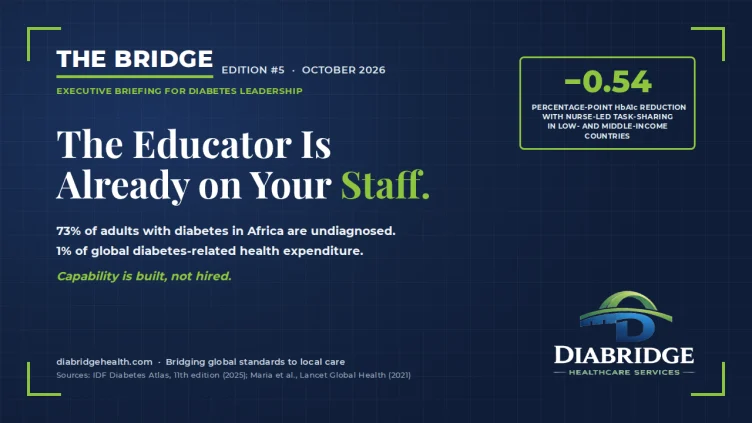
The Educator Is Already on Your Staff
The educator your hospital needs may already be on your staff. This edition explores how structured training, supervision and clear accountability can build diabetes education capability within existing teams.
-
The Bridge
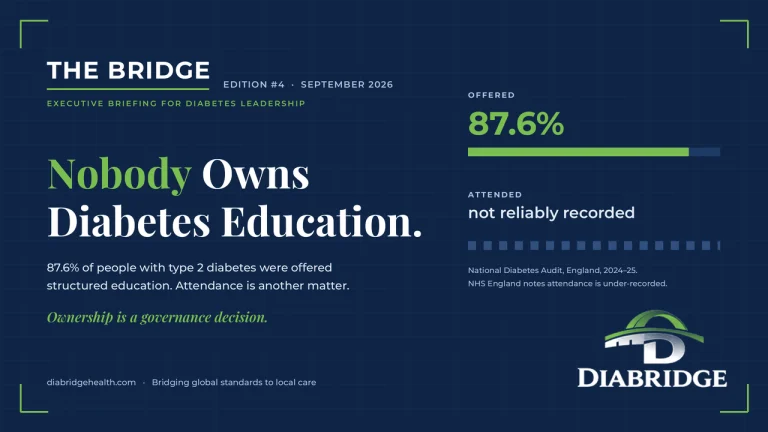
Nobody Owns Diabetes Education.
87.6% of people with type 2 diabetes in England were offered structured education. Attendance is another matter.
-
Conversations
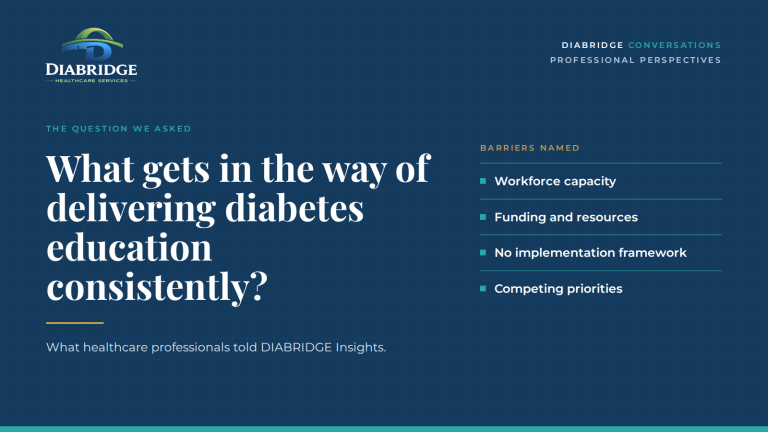
What gets in the way of delivering diabetes education consistently?
Our first DIABRIDGE Conversation asked healthcare professionals one question: what is the greatest barrier to delivering evidence-based diabetes education consistently? Their answers informed DIABRIDGE Insights Executive Brief 01.
Read about What gets in the way of delivering diabetes education consistently?