The Bridge Edition 05
Executive briefing for diabetes leadership
The educator your hospital needs may already be on your staff. This edition explores how structured training, supervision and clear accountability can build diabetes education capability within existing teams.
The Bridge · Edition 05 · October 2026
Executive briefing for diabetes leadership
Why closing Africa’s diabetes education gap is a workforce capability decision, not simply a recruitment problem
Editor’s Perspective
Last month I argued that nobody owns diabetes education. Responsibility is spread across a team, so in practice it often belongs to no one.
Most leaders I speak to agree with the problem. What stops them is the next step. At our July Forum, “we don’t have an educator” came up again and again, as if the work can’t start until a specialist arrives.
I understand that. But I started my career as a healthcare assistant. The clinical knowledge and education skills I have today as a Senior Diabetes Specialist Nurse were built over time, through formal learning, clinical experience, supervision, and people who invested in my development.
That experience taught me something important: capability can be built. This edition is about how hospitals can build it.
Dorathy Oparaeche
Founder and Clinical Lead, DIABRIDGE
Cover Story
Many hospitals are waiting for a diabetes educator they may never be able to hire. Meanwhile, patients are diagnosed, prescribed and sent home every day without anyone explaining what comes next.
The workforce to close that gap may already be on the ward. What is often missing is the structure that develops, supports and assures their capability.
The waiting problem
When education depends on a specialist post, it stops whenever that post is empty. In many African hospitals, the post has never existed. So education happens by chance: a kind nurse with ten spare minutes, a doctor who rushes through the basics, a leaflet if there is one.
Waiting for the perfect hire feels responsible. In practice, it means another year of patients going home unprepared.
Task-sharing is not task-dumping
Evidence from low- and middle-income countries suggests that diabetes care and education tasks can be shared with nurses and other non-physician staff, but how those roles are set up matters. A Lancet Global Health meta-analysis found that nurse-led interventions in low- and middle-income countries lowered HbA1c by about half a percentage point on average, see
Evidence in Focus
But the same review carries a warning. In the small group of African trials, the pooled effect on HbA1c was close to zero. That subgroup is small and uncertain, so it does not show that nurse-led education fails in Africa. It does show that handing someone the task is not enough.
A nurse told to “also do the diabetes teaching”, with no training, no protected time and no one checking, will do her best. Then the ward gets busy, and education is the first thing to go.
Capability has to be built
The educator may already be on your staff. That doesn’t mean they are already equipped to be the educator.
A 2023 study of 100 primary care nurses in the Eastern Cape found their diabetes knowledge scores were high. But knowledge wasn’t linked to how confident they felt, or to how much they actually helped patients manage their diabetes. Confidence was. The authors called for specific training, experienced mentors, clear guidelines and joined-up chronic care systems.
Knowing about diabetes and teaching it well are different skills. The second has to be developed on purpose.
What makes it work
The hospitals that make this work treat education as a service, not a favour. In practice that means five things:
- A named person. Each ward or clinic has a designated nurse who leads education, and everyone knows who it is.
- Structured training. That nurse is trained to a defined standard, not left to work it out alone.
- A shared curriculum. Every patient gets the same core content, whoever delivers it.
- Supervision and support. Someone senior reviews the work, answers questions and keeps standards up.
- A record. Sessions are logged, so leaders can see who was taught, and who was missed.
None of this needs a new department. It needs a decision.
The real question
The question for hospital leaders is not “Do we have a diabetes educator?”
Do we have a system that produces one?
If the answer is no, the gap will stay open, whoever you hire. If the answer is yes, your next educator is probably already on your staff.
What We’re Learning
Our first DIABRIDGE Forum on 31 July brought together healthcare professionals to talk about structured diabetes education. The session wasn’t recorded, so people could speak openly. These are the themes that came up, without names.
- There is often no educator. Many hospitals have no one whose job is to teach patients about diabetes.
- Doctors don’t have the time. Consultations are short, and teaching gets squeezed out.
- Education isn’t routinely offered. Many patients are never invited to any structured session.
- Medicines are hard to get and to afford. Education has to work alongside real limits on access and cost.
- People want it. There was strong agreement that structured education would help patients.
The first two points led directly to the question we’re taking on at our October Forum: if there’s no educator and no doctor time, who is left to teach?
Evidence in Focus
Nurse-led task-sharing can improve diabetes outcomes in low- and middle-income countries, but results vary substantially between settings.
Maria et al., Lancet Global Health, 2021 (published online November 2020) is a systematic review and meta-analysis of task-sharing for type 2 diabetes in low- and middle-income countries.
What they looked at. Randomised trials in which nurses, pharmacists, dietitians or community health workers took on diabetes tasks normally done by doctors, compared with usual care. Lifestyle education was part of almost every intervention.
What they found.
- 46 trials were included, with 16,973 participants. Of these, 24 trials were pooled for HbA1c.
- Nurse-led interventions lowered HbA1c by 0.54 percentage points on average (95% CI −0.89 to −0.18). The evidence was graded as moderate certainty.
- Pharmacist-led interventions lowered HbA1c by 0.91 points. Community health worker interventions showed no meaningful reduction.
- For trials in the WHO African Region, the pooled change in HbA1c was +0.08 points (95% CI −0.23 to 0.39), meaning no clear effect.
How to read it. Heterogeneity was high, so averages hide large differences between settings. The African subgroup is small and its confidence interval is wide. It should not be read as proof that nurse-led education fails in Africa.
Closer to home. A 2024 scoping review in Frontiers in Public Health (Sajith et al., University of Salford) set out to map nurse-led diabetic foot prevention services and education programmes in sub-Saharan Africa. It found no nurse-led programmes focused only on foot prevention. All ten studies it included, across 14 papers, were broader nurse-led diabetes self-management education programmes. Those linked to better glucose control and self-care focused on behaviour change and were co-produced with patients. The authors call for nurse-led education that is co-produced, culturally appropriate, low-cost and sustainable.
Why it matters for leaders. The Maria et al. authors conclude that roles for non-physician staff need to be restructured and properly organised, with adequate training and supervision. They point to standardised training, clear guidance, reliable patient data systems and logistical support as key facilitators. In other words, the cadre matters, but the structure around it matters just as much.
Numbers That Matter
The need
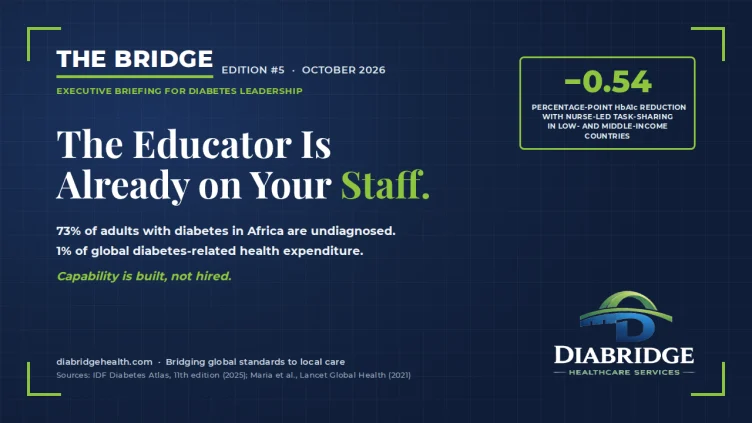
73% of adults living with diabetes in Africa are undiagnosed (72.6%), the highest of any IDF region.
1% of global diabetes spending (USD 10 billion) goes to the IDF Africa Region.
−0.54 percentage-point average HbA1c reduction with nurse-led task-sharing in low- and middle-income countries.
IDF figures are for adults aged 20–79 in the IDF Africa Region, from the IDF Diabetes Atlas, 11th edition. HbA1c figure from Maria et al.
Around the World: South Africa
South Africa built a nurse-led chronic disease model, tested it honestly, and kept improving it.
In the Western Cape, Primary Care 101 set out to expand nurses’ role in managing chronic conditions, including diabetes. Nurses in 38 public clinics took part in a cluster randomised trial. Those in intervention clinics were trained through educational outreach to use a clinical management tool, and were authorised to prescribe a wider range of medicines (Fairall et al., PLoS Medicine, 2016).
The results were mixed. The expanded nurse role proved feasible and safe, but it did not increase treatment intensification or case detection, the trial’s main measures. Even so, the model was adjusted and adopted for primary care clinics across South Africa.
The lesson for hospitals: a nurse-led model is not a one-off training event. It is built, measured, and refined. Leaders who expect the first version to be perfect will give up too early.
Looking Ahead
DIABRIDGE Forum: No Educator, No Education?
Building diabetes education capability within existing teams.
Friday 30 October 2026, 12:30pm (UK time), online via Zoom. Free to attend and not recorded.
We’d like to hear from nurses, doctors, pharmacists, dietitians and hospital leaders who are dealing with this every day. Register your interest and we’ll send you the Zoom link before the session.
Institutional Diabetes Education Leadership Survey 2026
If you lead or manage clinical services, tell us how education is organised in your institution. It takes a few minutes.
At DIABRIDGE, this is the problem our Link Nurse Certification™ pathway is designed to address: giving hospitals a structured way to develop education capability within the nursing teams they already have.
The Bridge is published monthly by DIABRIDGE Healthcare Services Ltd. Bridging global standards to local care. Read past editions and subscribe at diabridgehealth.com/insights.
Sources
- Maria JL, Anand TN, et al. Task-sharing interventions for improving control of diabetes in low-income and middle-income countries: a systematic review and meta-analysis. Lancet Global Health. 2021;9(2):e170–e180. Read the study.
- Sajith R, Ackers L, Ackers-Johnson S, Parker DJ, Stephens M. The practice, nature, and impact of nurse-led type 2 diabetic foot prevention services and educational programs in Sub-Saharan Africa: a scoping review. Frontiers in Public Health. 2024;12:1465750. Read the review.
- Landu ZK, Crowley T. Primary health care nurses’ knowledge, self-efficacy and performance of diabetes self-management support. African Journal of Primary Health Care & Family Medicine. 2023;15(1):a3713. Read the study.
- Fairall LR, et al. Educational outreach with an integrated clinical tool for nurse-led non-communicable chronic disease management in primary care in South Africa. PLoS Medicine. 2016;13(11):e1002178. Read the study.
- International Diabetes Federation. IDF Diabetes Atlas, 11th edition. 2025. Africa regional report. View the report
The Bridge is intended for healthcare professionals and organisations. It provides general information and does not constitute individual medical advice.
Subscribe to The Bridge
A short email each month when a new edition is published, with a link to read it in full.
Related Insights
-
The Bridge
Nobody Owns Diabetes Education.
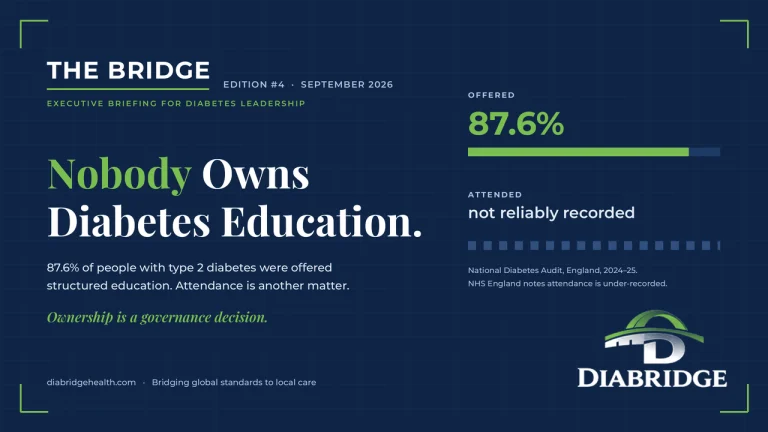
87.6% of people with type 2 diabetes in England were offered structured education. Attendance is another matter.
-
The Bridge
Africa’s Diabetes Decade Has Already Begun
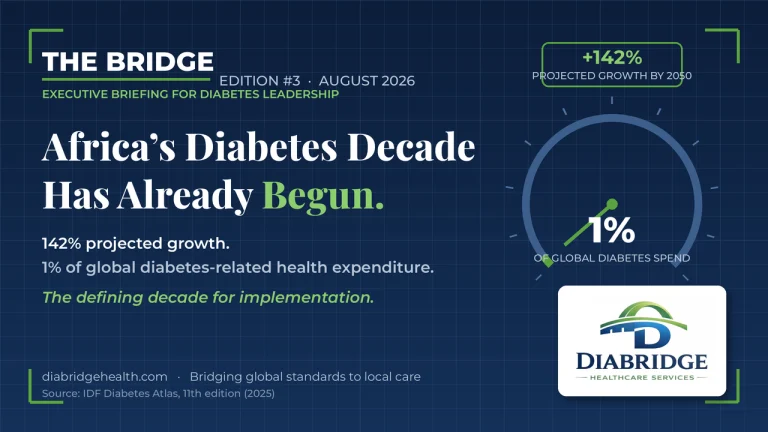
142% projected growth. Approximately 1% of global diabetes-related health expenditure. Africa’s defining decade for diabetes implementation has already begun.
-
Conversations
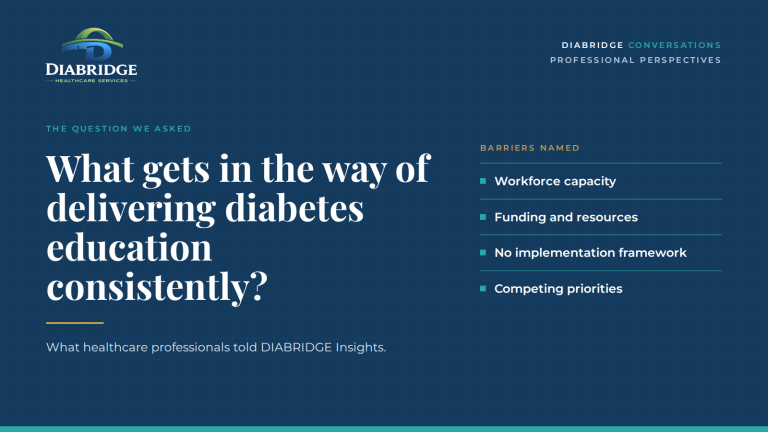
What gets in the way of delivering diabetes education consistently?
Our first DIABRIDGE Conversation asked healthcare professionals one question: what is the greatest barrier to delivering evidence-based diabetes education consistently? Their answers informed DIABRIDGE Insights Executive Brief 01.
Read about What gets in the way of delivering diabetes education consistently?